
In certain circles, CATAN is a board game that needs no introduction. In the larger sphere of popular culture, however, it’s still tucked tightly into its niche. It may well be the Star Wars of board games, being largely responsible for rejuvenating and redefining an industry, launching a thousand imitators and dozens of its own spin-offs and sequels. Still, it sits somewhere alongside Thunderbirds in the collective consciousness.
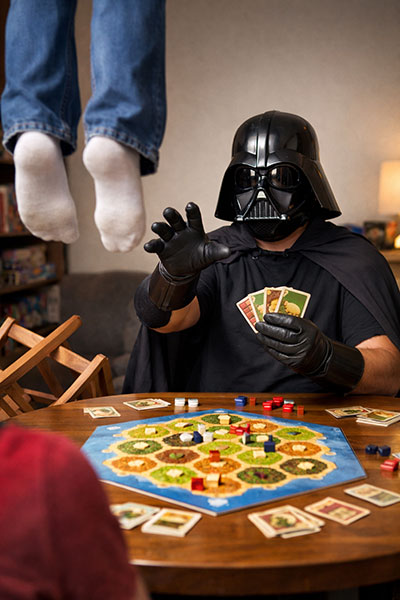
“I find your lack of wheat disturbing.”
Thunderbirds is probably the most well-known and recognizable television show featuring marionettes, but you couldn’t fault the average person-on-the-street for never having heard of it. CATAN is to Monopoly as Thunderbirds is to The Muppet Show: it’s not the pinnacle of all television shows featuring puppets, but it IS the exemplar if we narrow the category by attaching a few strings.
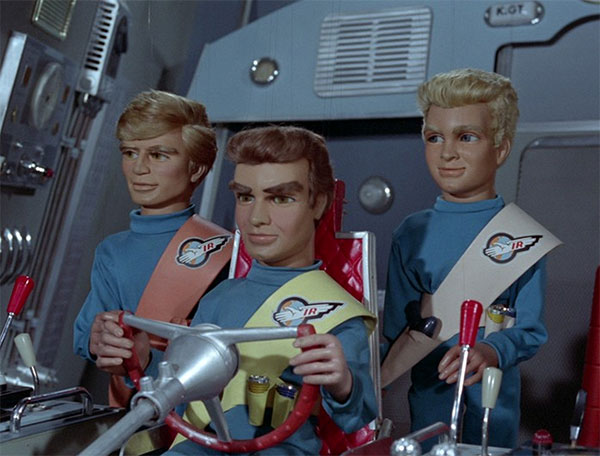
Thunderbirds: of the British sci-fi series from the 1960s that featured Supermarionation, it was the best
It’s entirely fair to hold CATAN up to pop culture at large in this way, as the studio’s own clear ambition is to build CATAN into a ubiquitous brand with household-name status.
Skeletons in the Board Game Closet
Created in Germany in 1995 by late designer Klaus Teuber, CATAN is largely credited for kicking off the modern board game renaissance when, like the Beatles, it crossed the Atlantic and enjoyed (comparatively) immense popularity in the USA in 1996. It’s a strategic board game set on a fictional, unpopulated island, although the game was initially called The Settlers of CATAN, and the island was most definitely populated. One questionable expansion cover featured handsome European settlers trading with stereotypically sexy natives styled like svelte brown Barbie dolls, evoking Disney’s problematic Pocahontas.
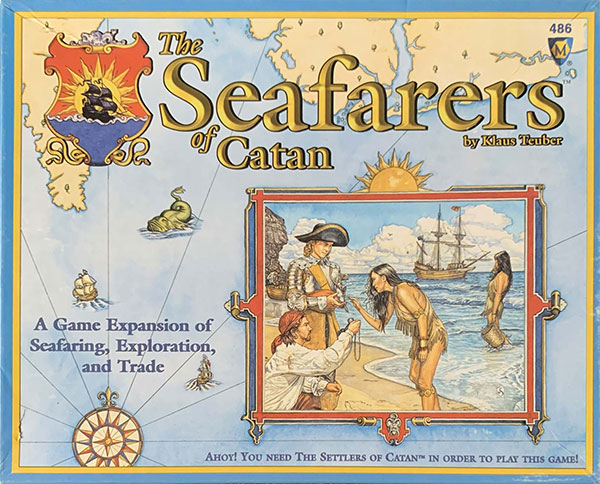
Ever touch a string of beads, little lady?
In response to increasing cultural sensitivity around colonialism, Dutch publisher 999 Games dropped “Settlers” from the game’s title. In ensuing editions, developer Catan Studio retconned the game’s lore and artwork so that no natives were harmed in the settling of this island.
Take Me to Church
Catan Studio has since carefully cultivated an inoffensive set of timeless painterly visuals for the franchise, which emphasize wholesome homestead-y Mennonite-esque farming and mining, carried out exclusively by white characters. The painterly, trad-wife visual style helped the game catch on in church rec halls, where Christians were finally able to enjoy a game free from gambling connotations and occult imagery, like the “Satanic” face cards in a standard Bicycle deck.
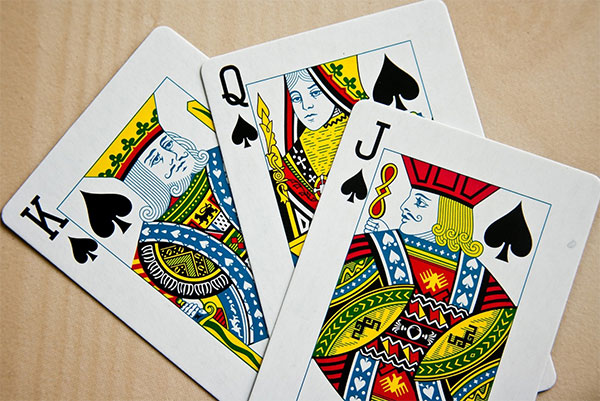
Get thee behind me, Satan
One of my own first experiences playing CATAN was at a tournament staged in a church basement. The Settlers of Zarahemla and The Settlers of Canaan are officially licensed versions based on the Book of Mormon and the Hebrew Bible respectively.
Your Number’s Up
The Catan landmass itself comprises colourful cardboard hexagonal tiles hemmed in by a blue oceanic frame, which was an innovation introduced in later editions. The size of the island increases by player count; the sold-separately expansion box accommodates up to two extra players, making CATAN a 3-6 player game.

Each of the island’s hexagons yields a different resource: forests produce wood, fields produce wheat, pastures produce wool, mountains produce ore, and hills produce the clay to make bricks.
Non-producing desert tiles make certain areas less valuable. During the setup stage, which is played in “snake order” (starting with the first player, proceeding to the last, and then reversing through everyone back to the first) players place two small settlement pieces shaped identically to Monopoly’s houses, which sit at the intersections if the tiles. Players also connect a matchstick-shaped road to each of their settlements, as a bid to expand further along the island on successive turns. In North American versions, these pieces are made of wood, while in the game’s native Germany, they are made of plastic.
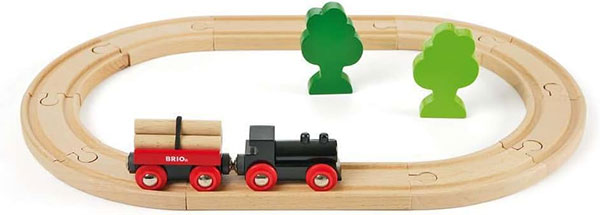
In North America imported wooden toys, such as Swedish Brio trains, tend to connote high quality, adding to CATAN’s appeal.
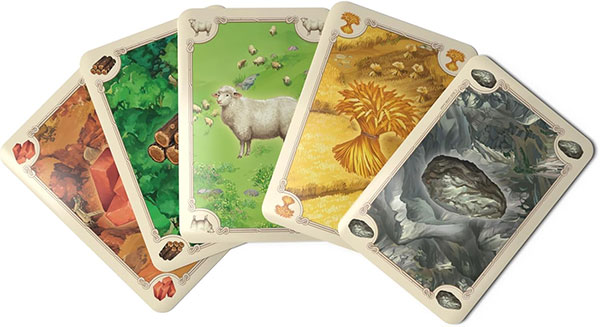
This initial placement stage is key, as it could potentially decide the entire game. On each hexagon is a tile numbered 2-12, with pips indicating the probability with which that number can be rolled using two dice; every turn, the active player tosses the pair of dice, and the result compels any hexagon with a matching number to produce resources for players whose settlements border that tile. These resources are tracked with paper cards that players collect in their private hands, of a size and stock familiar to anyone who’s had to sit through a game of Go Fish.
Each player has an identical menu of different structures they can build, which lists various “recipes”: a road costs one brick and one wood resource, while upgrading a settlement to a city (which enjoys a double yield when neighbouring numbers are rolled) costs three ore and two wheat. Building a new settlement costs one of each resource except ore. Players compete to press into and around the island, extending their reach by building new roads, and camping on new intersections by building additional settlements. Each settlement and city is worth 1 and 2 points respectively, and the first player to end their turn with ten or more points wins the game. That’s the game loop: roll the dice, all players collect resources where applicable, build and/or trade, and then pass the dice on clockwise until one player ends their turn with 10 or more points.
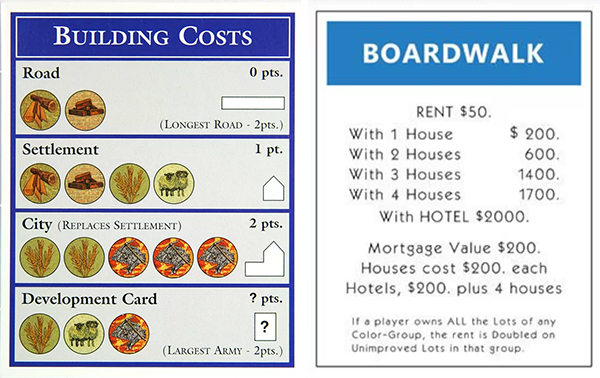
Left: a CATAN Building Costs card. Right: a Monopoly property card.
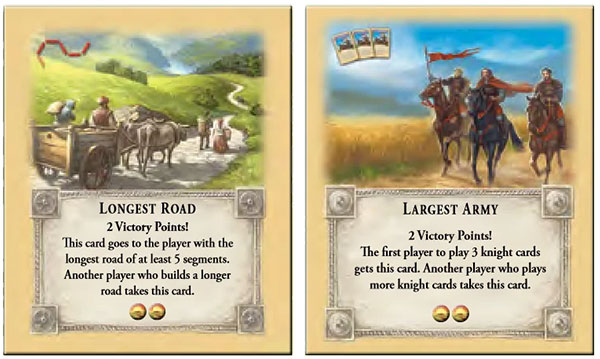
There are additional nuances, of course. One recipe item buys players a Development Card, which could confer points, free roads, or a Knight (originally called a Soldier), which lets a player move a grey robber pawn (which in early editions was painted black – yikes) to any tile on the board, claiming a card from any one player whose settlement borders that region. Any player who rolls a 7, the most common outcome from a pair of six-sided dice, likewise gets to move the robber. Two cardboard tiles labelled Longest Road and Largest Army are awarded to players who maintain 5 or more road segments, or 3 or more Knight cards played. Each of these cards is worth 2 points, but they can be claimed by any player who overtakes the lead in either category. Settlements and cities, which must be placed two edges away from other settlements or cities, can be built to interrupt roads, allowing players to curtail their opponents’ Longest Road bids.
Finally, the last major (and perhaps most controversial) aspect of the CATAN is its trading mechanic. Originally limited to the first phase of a player’s turn (once upon a time, the official rulebook forbade you from trading once you had paid resources to build something), trading allows players to swap resources with the game’s supply at a 4:1 ratio. The exchange sweetens to 3:1 if your settlements are camped on certain harbour spaces along the edges of the board. Some harbours allow for a 2:1 trade if you pay specific pairs of resources. Alternatively, players can trade their resources with other players.
And ay, there’s the rub.

Trouble in Pair o’ Dice
Among modern board game afficionados, it is a widely held opinion that CATAN has more than a few gameplay problems. Even among pop culture enthusiasts, for whom CATAN may be their first foray into the board game renaissance, CATAN throws up an obstacle in an equal but opposite way that video games do: with video games, it’s possible to start off strong, but then become hopelessly stuck, whether due to fine motor control inadequacy, or the inability to solve a particular puzzle.
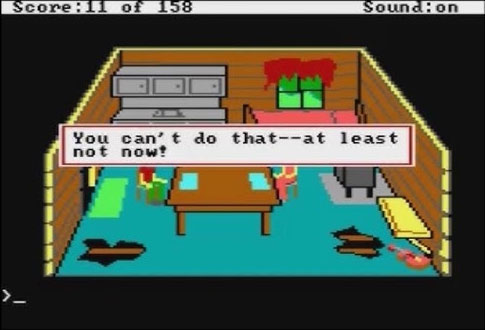
> THROW COMPUTER OUT WINDOW
With CATAN and other board games of its ilk, the problem is an inability not to continue, but to even start. After all, this review has spent three full paragraphs synopsizing the game’s rules, which are explained across dozens of full-colour pages in the CATAN’s cryptically written rulebook. i learned how to play CATAN from two friendly neighbours. i had no idea how inscrutable the rulebook was until i sat down years later to teach the game on my website Nights Around a Table (where my How to Play CATAN and CATAN: Cities & Knights tutorials are my third and second most-viewed videos, with half a million views between them). Daunting rulebooks are great for business on my instructional website, but they do little to endear board games to a broader audience. Writing for Dicebreaker, Alex Meehan calls CATAN “a terrible introduction to the hobby.”
While modern board gaming owes a considerable debt to the game, we are now (again, thanks to CATAN) spoiled for choice. My own personal collection contains hundreds of games, and CATAN ranks pretty low on the list of titles i reach for when a board game crisis arises. As “accessible” as the game is purported to be, and despite it being scarcely more complicated than Monopoly (which players tend to learn as children, when their minds are still fresh and absorbent), many new players’ eyes go crossed when they are pressed to learn how to play CATAN, even by oral tradition instead of opaque rulebook. Indeed, when tasked with teaching CATAN to board game muggles, i rely on Monopoly as a familiar touchpoint: “This card tells you the recipe for roads and settlements, just like Monopoly has a card with recipes for houses and hotels. See? See how a settlement looks just like a Monopoly house? Don’t freak out. Stop crying.”
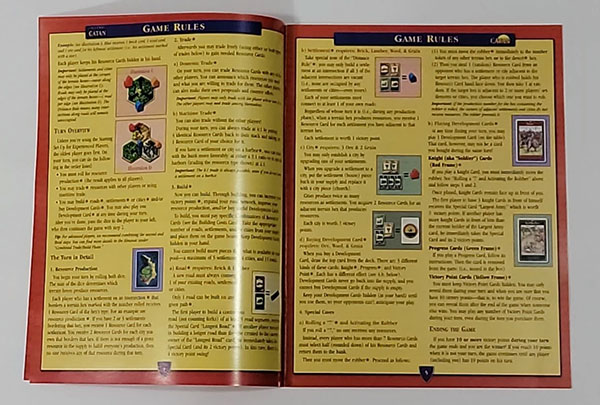
Looks like a fun Friday night. *cough*
For certain board game players, anything involving dice rolling or randomness is a non-starter. Players who place a premium on strategic skill demand absolute, deterministic control. Neil Thomson’s Destination Geek review on boardgamegeek.com calls its potentially underwhelming turns, where a player may roll the dice and pass them along, unable to take further action, “not a good time.” It’s possible, especially as a new player, to botch that initial placement phase in a way that completely torpedoes the rest of the game. In other circumstances, while it’s statistically unlikely, it’s possible that the numbers bordering your settlements just don’t get rolled, like Tom Stoppard’s Rosencrantz flipping a coin and coming up “heads” 92 times in a row.
Some players can feel “abused” by the robber, as vindictive players constantly target their most important hexagons. For other purists, the trading mechanic is what tanks CATAN: players can form alliances, or trade inexpertly, putting other players at an unfair disadvantage. The equivalent example in a more well-known game like Scrabble occurs when, in a 3-4 player game, an inexperienced player extends the communal crossword puzzle towards a high-value Triple Word Score square, which the next player can immediately exploit to the exclusion of their opponents.
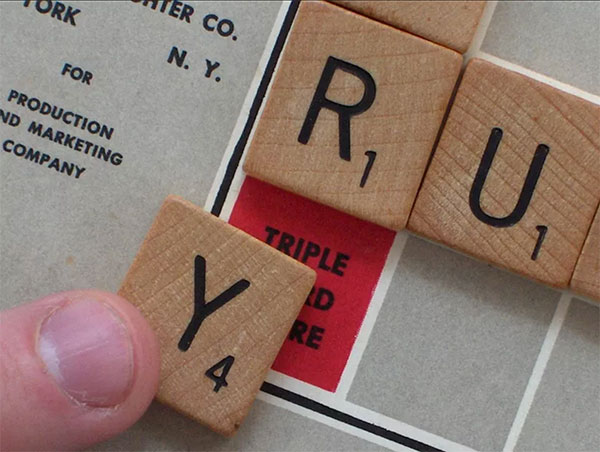
72 points for WIZARDRY?? Time to disinvite Pete from board game night.
CATAN’s aptly named “Monopoly” development card, which siphons all instances of a certain resource from players’ hands, provides ample cause to flip the table. Players tend to gang up on the points leader. In its final stages, CATAN commits the cardinal board game sin of facilitating “king-making,” where one player who stands no chance of winning can decide to supply crucial resource cards to a leading player, tipping the scales in their favour unfairly.
All of these shortcomings usually disqualify CATAN amongst hobby board game players who have simply moved on, searching for different and better games that have more fair-minded mechanics. If board game and video game players alike can agree on anything, it’s that game design improves over time — what was new and hip in 1996 has been supplanted in the ensuing decades with what are widely regarded as better-designed games. To put this point in video game terms, 1996 was the release year for Crash Bandicoot, Quake, and the original Tomb Raider. Modern players tend to seek these games out only as historical novelties. There are simply better, fresher alternatives.

Polygons sharp enough to cut glass.
Respecting Our Elders
But CATAN slander makes it easy to forget the aspects that made the game appealing to begin with. The game’s modular board was a tremendous innovation, contrasting games like Power Grid, Nucleum, and supposed CATAN-killer Concordia, for which players must purchase additional boards just to vary the landscape. While its mechanics are superficially reminiscent of Monopoly, CATAN’s decision space is considerably broader and more interesting; where Monopoly’s only choices are whether to buy or bid for a property, when to build real estate, and how long to stay in jail, CATAN players must weigh the values of certain properties against dice probabilities, decide how and where to expand, choose whether or not to trade and at what rate, and consider how best to spend their hard-rolled resources. This comes in a fraction of the time it takes to finish a game of Monopoly, and without that game’s downbeat player elimination mechanic or fistfight potential. As opposed to games with (what came to be dubbed as) a “down time” problem, where players twiddle their thumbs waiting for opponents to finish their turns, CATAN keeps players engaged even when they’re not holding the dice: everyone watches carefully on every turn for their numbers to be rolled, or to hear if the active player needs any of their resources in trade. Not least, CATAN is famously the game that lets you announce to the table that you’ve got “wood for sheep,” wink wink.
Fumbling Towards Ubiquity
Like an aging rockstar shuffling up to the podium to accept a Hall of Fame induction, CATAN has certainly earned its bona fides, including its Spiel des Jahres win in 1995. As an early entry in a wellspring of hobbyist board games that it inspired, CATAN looks and plays a little long in the tooth, outmoded by shiny new titles that improve on its shortcomings. As an easy-level Jeopardy! or crossword puzzle clue, CATAN — and strategy board games in general — still has a Longest Road to travel before it can be included in the instantly recognizable pop culture pantheon that includes the likes of Pac-Man, The Backstreet Boys, and Risk. As an improvement on classic pop-a-matic, roll-to-move Milton Bradley and Parker Bros. fare, given the choice between Monopoly and CATAN… good God, give me CATAN.






0 Comments